How can brands harness the Transformation Economy?
Behavioural and societal shifts are changing what brands need to consider if they want to stay truly connected with their customers: Transformation of self, is a lever at the heart of all this.
Because, as the world continues to care more about personal growth, self-improvement, and becoming the best version of themselves, there is a shift from consumers merely wanting experiences from products to wanting those products to instil lasting transformation in their lives.
We see this everywhere, with the uptake of gyms and outdoor exercise – a stat from 2025 also showed that 73% of 16-25-year-olds say they prefer exercising outdoors in nature over working out in a gym. We have seen it through our work with the Field Studies Council, where we worked with the Council to help them connect with the growing numbers of people wanting to transform themselves.
People want to transform. So what does this mean for brands and behavioural science?
First, What is the Transformation Economy?
Termed by B. Joseph Pine II, the transformation economy marks a shift where the greatest value comes from not what brands sell, or the memories they provide, but from how they change people’s lives.
So, how did we get here?
The transformation economy hasn’t come from nowhere. The progression of economic value over time shows consumers are naturally shifting towards more personal, more valuable forms of exchange.
We started with commodities – raw materials straight from the earth, like fruit and coffee beans, sold purely on the basis of price and supply.
Then came goods, where those raw materials were turned into tangible manufactured items, through factory assembly and adding packaging.
Next, services, referring to intangible but arguably more valuable offerings. Think anything from waiters and cabin crew, to plumbers and painters.
More recently, we’ve been living in the experience economy, characterised by memorable events that engage people, like visiting a pop-up. It was all about what people could do and get involved in.
But it seems that experience is starting to get treated as a commodity in its own right. And with that, there’s a new economy on the block: transformation.
Transformation can be as simple as a notetaking app helping someone become an organisational guru, or a health brand allowing someone to become a family-oriented adventurer.
It’s not about providing a short-term burst of ability – it’s a long-term change in who you are or how you operate. To be clear, this isn’t about metamorphosis, or unlocking some alter-ego superhero within you. It’s simply about brands facilitating the goals you’ve always been working towards.
Helping People Become the Person They’ve Always Wanted to be
The idea that people aspire to become the best version of themselves is not a new one.
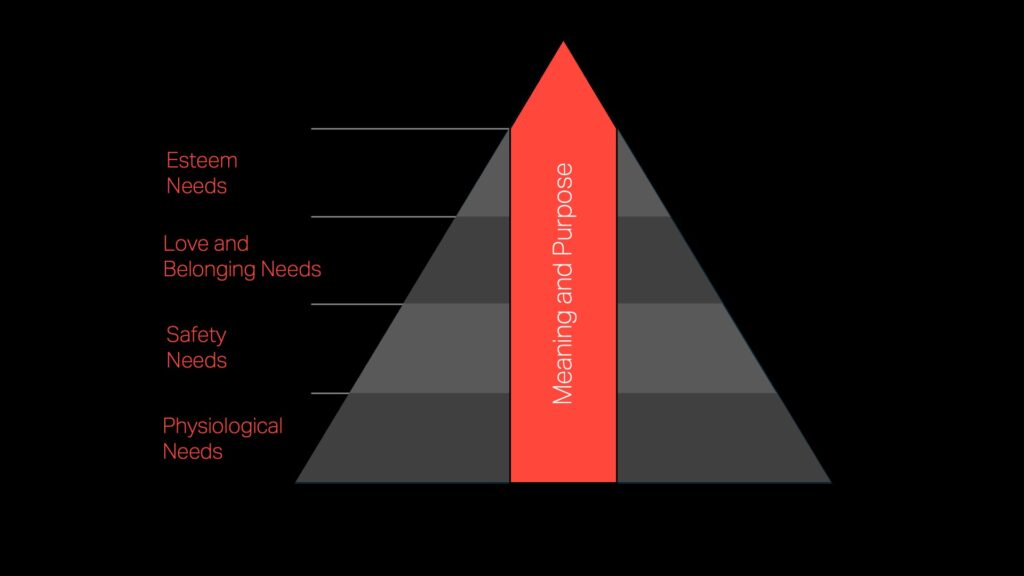
Maslow’s hierarchy of needs has been around for decades, arguing that people are motivated by five basic levels of need, whereby satisfying one allows you to move onto the next: physiological, safety, love and belonging, esteem, and self-actualisation. Self-actualisation, at the top, sits neatly in line with what’s driving this new economy.
But many, including Pine himself, argue Maslow got the order slightly wrong – where self-actualisation and meaning sit at the top of the pyramid, meaning should actually sit at the bottom.
He may have a point.
As human beings, we crave meaning and purpose. And increasingly, people seem to be looking to brands to facilitate it.
Why Exactly is This Happening Now?
Although there isn’t a single answer, it seems there’s simply a growing desire for self-development these days.
Take the boom in wellness and self-improvement behaviours. From fitness tracking and runs, to therapy and new diets, people are working on themselves inside and out.
Separately, institutional trust seems to be declining, whether it be due to demographic, economic, or political factors. Perhaps where institutions are failing to connect with people, brands are stepping in to fill that gap.
And then there’s social media, where the constant, conscious curation of a public image makes people more aware than ever of the gap between who they are and who they want to be.
The Bigger Picture
The transformation economy doesn’t necessarily mean less consumption. It just means a shift in what’s being consumed and why. Instead of paying for a raw material or a good, people are, in a way, increasingly paying for a better, improved version of themselves.
That’s not quite a move beyond materialism. It’s the same logic of growth but redirected towards the self instead of towards things.
And worth considering alongside this is the existence of Doughnut Economics. Developed by Kate Raworth, it’s argued that economies shouldn’t pursue growth for growth’s sake at all. It was one of our Books of 2025!
The doughnut idea can be broken down into a few pieces. The first ring of the doughnut represents a social foundation, referring to baselines like food, water, health, housing, and income that everyone needs to live. If you fall short of that, you land in a hole of deprivation.
Then there’s an ecological ceiling, referring to the limits we can’t safely exceed without real consequences – examples ranging from biodiversity loss to climate change. Overshoot that and you end up outside of the doughnut altogether into ecological breakdown.
The safe space to be is in the doughnut itself – the area between the two, where humanity’s needs are met without breaching that ceiling of what the planet can sustain.
The transformation economy, by contrast, is a business strategy – it is a way of capturing value by selling outcomes rather than objects. Doughnut economics doesn’t distinguish between kinds of growth, but rather questions the logic of pursuing growth at all, transformation included.
Where the transformation economy asks whether a brand can profitably help someone become a better version of themselves, doughnut economics asks whether that becoming serves the person and the planet, or simply repackages consumption as self-improvement.
It’s important to note that these aren’t incompatible frameworks.
If the growth a brand is facilitating is genuine – truly building wellbeing or connection with respect for the environment – it can scale from the individual to society without breaching the ecological ceiling in question.
But it’s not an automatic process.
It takes brands designing transformation deliberately, with equal attention to what it costs to deliver as well as what it’s worth to sell.
The question therefore worth asking isn’t just a matter of “does this create value?”, but “whose growth is this actually serving, and at what cost?”.
Brands Can Help Facilitate This Becoming
Brands sit in the middle of that question, and answering it well starts with how they approach the transformation itself. Specifically, that means moving beyond the personalisation we’ve long seen towards individualisation, by tapping into specific, relatable scenarios and the role a brand can play within them.
The brand’s role isn’t to tell the consumer what to do – it never has been. It’s to guide and facilitate, wherever the consumer needs them to, but more importantly, wherever the brand naturally fits.
Just as every person is different, so is every brand. This isn’t about forcing a purpose into people’s lives, but about fitting around them. This means a brand needs to know what it stands for, first and foremost. Are you still simply selling a product, or an experience? Or are you selling an outcome?
And this is essential for business strategy, because as Pine says in Forbes Magazine, “Ascending to the proposition that you are in the transformation business creates that shift that then will enable you to figure out how to guide customers to achieve the outcomes they desire.”
It’s also worth noting that whilst this is crucial for consumers, the transformation economy expands beyond them, to employees too. Whether it’s about transforming them into specialists through skill-building, or into stronger communicators and collaborators through soft-skill development, any relationship with a brand should have a transformative outcome.
Ultimately, facilitating people’s transformation only works if you understand them first – their needs, goals, and desires. And as those develop over time, so must the transformation on offer. The transformation economy isn’t static; it’s a dynamic system that has to adapt as society, and the context around it, keeps shifting.
So, once you know who you are as a brand, as well as who you exist for and why, you can start to prove that you have the right, and the means, to help people transform their lives – for them, not just for you.