Where people get their news should worry every brand
Where people get their news is a significant cause for concern – and not just for journalists.
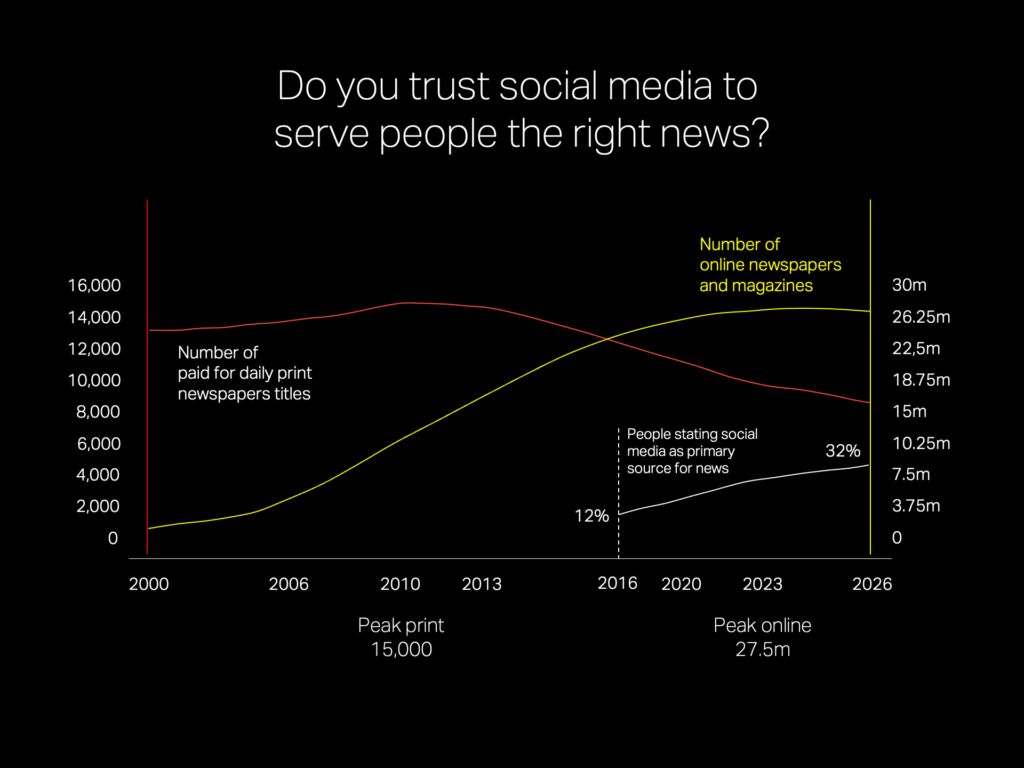
The shape of the change is stark. The number of paid-for daily print newspaper titles worldwide peaked around 2010, at roughly 15,000, and has since fallen by more than a third. The number of online newspapers and magazines exploded through the 2000s and 2010s before plateauing in the early 2020s at somewhere north of 27 million. And cutting through both curves is a third line: the proportion of people who say social media is their primary source of news, which has nearly tripled in a decade – from around 12% in 2016 to over 30% today.
These figures are directional estimates rather than precise counts, but the shape of the story is not in dispute. The question is what it means. Most commentary stops at the implications for democracy. We think there is an equally pressing question for anyone responsible for a brand’s relationship with its customers – or its employees: What happens to trust when the curators disappear?
As Reuters itself reported – and yes they have a vested interest – “The shift to social media as a primary news source accelerates public mistrust in brands and institutions because these platforms are optimized for engagement rather than factual accuracy. This environment fosters polarisation, increases exposure to misinformation, and blurs the lines between entertainment, commentary, and verified reporting.”
In short – brand starts to evaporate.
A few other questions also emerge: Do we trust people to serve each other the right news? Or does this lead to a dangerous echo chamber emerge where a polarity of views start to rule the roost? And what does this mean for brands?
Trust travels through people like us
Behavioural science offers a starting point. In Nudge, Richard Thaler and Cass Sunstein devote a chapter – “Following the Herd” – to social influence: the overwhelming tendency of human beings to take their cues from other people, and especially from people they identify with. They describe how conformity pressures shape everything from the answers people give in perception experiments to whether households pay their taxes – citing a Minnesota study in which simply telling taxpayers that most of their neighbours had already complied did more to improve compliance than threats or appeals to conscience.
The lesson is uncomfortable for institutions: the messenger often matters more than the message. We do not weigh evidence neutrally; we ask, consciously or not, “is this person like me?”
Social media is that insight, industrialised. A feed is a machine for delivering information through people we have chosen to identify with. It is, in Thaler and Sunstein’s language, a piece of choice architecture – and choice architecture is never neutral. Every default, every ranking, every autoplay decision nudges us somewhere.
The trouble is what this particular architecture optimises for.
Automatic by design
Thaler and Sunstein describe two modes of thinking: the Automatic System – fast, intuitive, emotional – and the Reflective System – slow, deliberate, effortful. (Readers may know these as System 1 and System 2, the terms popularised by Daniel Kahneman; in Nudge the authors use the friendlier labels.)
It would be too easy – and not quite honest – to claim the print era was a golden age of Reflective thinking. Tabloid front pages were engineered for the Automatic System long before the first algorithm ranked a feed. But the old model had two features the new one lacks.
First, curation was outsourced deliberation. When people got their news from the BBC, CNN, Le Monde, Bild, The Times of India or the New York Times, an editorial process – fallible, sometimes biased, but professional and accountable – had engaged its Reflective System on the reader’s behalf before anything was published.
Second, there was lag. News arrived in editions and bulletins. There was a gap between encountering information and being able to act on it publicly, and in that gap, reflection had at least a chance.
The social feed removes both. Curation is performed by an algorithm whose objective is engagement, not accuracy. And the gap between reading and reacting has collapsed to the width of a thumb. The Automatic System is not just engaged first; it is the only system the architecture requires.
Sunstein saw the second-order consequence coming. In #Republic, his study of social media and democracy, he describes how self-selected information environments become echo chambers, and sets out what he calls the law of group polarisation: when like-minded people deliberate only with each other, they don’t moderate – they move towards more extreme versions of what they already believed. The feed doesn’t merely reinforce bias; it amplifies it. Truth, which is often nuanced, slow and emotionally unsatisfying, struggles to compete.
The result is an audience – and a workforce – that is more reactive, more volatile, and more tribal in where it places its trust.
Parent, Adult, Child: what kind of relationship are brands building?
So what does this mean for the relationship between brands and the people they serve and employ? Here a second framework is illuminating: the transactional analysis developed by psychiatrist Eric Berne in Transactional Analysis in Psychotherapy and popularised in Games People Play. It’s a book I read when studying Drama at university and was an essential tool in helping me understand the power of status.
Berne proposed that in any interaction we operate from one of three ego states. The Parent speaks from authority – nurturing or critical, drawn from the figures who raised us. The Child responds with the emotion, spontaneity and reactivity of early life. The Adult is the reality-tester: the part of us that processes information on its merits, here and now.
Berne’s crucial insight was about the transactions between these states. Complementary transactions – where the response comes from the state being addressed – are stable and can continue indefinitely. Crossed transactions break communication down.
For most of the broadcast era, brands spoke as the Parent. Sometimes nurturing (“we’ll take care of you”), sometimes critical (“you should want this”), but always from a position of one-to-many authority. Audiences, having little channel to answer back, largely accepted the complementary Child position. It worked, after a fashion – Berne would note that Parent–Child transactions are perfectly stable. Stable, but not mature, and entirely dependent on the Child staying put.
Social media has changed the ego state of the audience – but not in the direction of the Adult. An environment engineered for the Automatic System is an environment that keeps people in Child: reactive, emotional, quick to delight and quicker to outrage. And it tempts brands into two equally damaging responses.
The first is to double down on Critical Parent: correcting, lecturing, issuing statements. Addressed to an audience in Child, this produces exactly the crossed transactions Berne warned about – defensiveness, ridicule, pile-ons.
The second is for the brand itself to perform the Child: chasing memes, feigning spontaneity, matching the audience’s reactivity tweet for tweet. Child–Child transactions can be genuinely playful, and occasionally they go gloriously viral. But Berne is clear that no reality-testing happens in the Child. A relationship conducted entirely in that register is engagement without trust – and it collapses the moment the brand needs to be believed about something serious: a recall, a restructure, a crisis.
The original question – what if we drift from adult/adult towards parent/child? – may therefore be slightly miswired. The drift is real, but the danger is not the Parent–Child dynamic itself, which is at least stable. The danger is that the Adult gets designed out of the relationship altogether, on both sides.
The opportunity: brands as the new curators
If the architecture of social media suppresses the Adult, the strategic opportunity for brands is to become places where the Adult is deliberately invited back in. Three implications follow.
- Be the trusted messenger, not just the message. Thaler and Sunstein’s evidence says people believe people like them. Brands that want to be trusted on social platforms need credible human voices – colleagues, customers, communities – rather than corporate accounts shouting from the Parent.
- Design your own choice architecture for reflection. Every owned channel – website, app, newsletter, intranet – is choice architecture you control. Where the platforms remove friction to accelerate reaction, brands can add just enough back to enable reflection: context before comment, sources alongside claims, time built into how decisions are communicated.
- Treat employees as the first audience. Your people get their news from the same feeds as your customers, with the same polarising effects. The organisations that thrive will be those whose internal communications behave like the trusted curators of old – accurate, contextual, ahead of the rumour – and that address their people Adult-to-Adult, especially when the news is hard.
The curated era is not coming back. But its most valuable export – the experience of being informed by someone who has done the thinking with you rather than the reacting for you – is now there for brands to claim. The brands that hold trust through the next decade will be the ones that talk to customers and employees as Adults, and give their Reflective Systems something to work with.