How do you build a Premier League organisation for your brand?
How do you build a high-performance organisation?
Last night I had the privilege of listening to Paul Barber OBE speak about how he has built a high-performance organisation at Brighton & Hove Albion Football Club.
Paul, alongside Chairman Tony Bloom, has seen the Albion go from a League 1 club (the third tier of English football) to 2nd in the Premier League (at the time of writing).
On that journey he has had to keep egos in check, define development pathways, and codify the values that have helped them grow the business.
Humble origins?
I think some of the best leaders are incredibly humble (I think I have a lot to learn). They are the first to talk about their limitations, and why they need to build great teams. They talk about their own imposter syndrome, and how they use this to have honest conversations. They are authentic and honest.
Paul’s own journey – in his own words – was one of failed footballer and failed coach before finding a career in finance with Barclays and marketing with Ogilvy. He’s clearly not a failure, but admitting his own failures is part of the story that helps others follow him.
After all, failures do not get offered plum roles by the English FA, which is what happened when Graham Kelly, the former CEO, asked Paul to join so that the FA could learn from the lessons of Euro ’96. How did they improve the football experience and monetise the game?
At the time he was at Barclays Bank and torn over what to do. The new role would mean a 50% pay cut when he had a young family to help support. It is one of those sliding doors moments when the heart and head are in discussion.
John Varley was CEO when Paul was at Barclays, and he gave him some advice which I’ll paraphrase (as I will throughout this blog): “Look, your heart’s not in this. It’s in football. You’ve got the chance to do something that will engage your heart and your head. People who have their heart and head in the same place are more successful and much happier.”
Wise words. He followed them. Going to the FA, then Tottenham, and the Vancouver Whitecaps, before arriving in Brighton.

Painting a picture
The complexity of a football business must not be underestimated. It’s features so many different disciplines in one place.
It’s worth defining football in its business context:
- It doesn’t manufacture anything – even merchandise sales are dependent on people
- It doesn’t create assets – there are no factories, machinery or software
- It doesn’t deliver critical services – the world will not stop without it
In essence, it’s an entertainment business that relies on human beings. It relies on athletes to entertain, professional experts to support them, and other employees to create the conditions where they can perform.
It’s a people business.
As Paul put it, “My job as CEO is to conduct this orchestra and get the best tune out of them, both on the pitch and off the pitch.”
And there is a lot to conduct. When you start to think about the operation, beneath the surface of players and coaches there’s medical teams, ground staff, marketing, HR, educations teams (yes, teachers), finance, ticketing, logistics, security, IT, the list goes on. And each of these perform a role off the pitch that is integral to getting the best from the teams each week.
Off the pitch is critical. As Paul told us “get it wrong there and it’s difficult to get it right on the pitch.” And here is one lovely story – I’ll call it ‘the cathedral builder story’ as some will see the parallel.
At the end of one season employees just missed out on a significant bonus – a bonus that would have been triggered by promotion. Paul gave a speech to staff the next day, a rallying cry about the difference that everyone can make in winning promotion the following season.
Straight after this speech one employee, a 70-year-old guy who parked the match official’s cars, pulled Paul to one side and said, “Hey that’s a great speech Paul, but I park the match officials’ cars. What can I do?”
Paul asked him to show him what he did and together they identified a few small details – like parking the car where the officials would get less grief from the fans; walking them to the match officials’ room; showing them where all the facilities are; making sure they know where they can get refreshments. You get the picture.
At this point Jeff (we’ll call him Jeff), says, “Yep, I can do all this, but it will take more time.”
Paul’s response is perfect: “Jeff, picture this. It’s the last minute of the game. We need a goal. Our striker is clean through. He gets brought down on the edge of the box. It’s right on the line. Could be inside the area. Could be outside. The ref’s got a decision to make. Jeff, you’ve taken great care of him. He’s felt the love. What’s he more likely to do?”
“I get it,” says Jeff.
The following season, Brighton got promoted.
The lesson for leaders? Paint the picture for every employee. Show them how the smallest of actions can add up to the biggest of differences.

And paint a picture people can aspire to
Carina Bauer is a Non-Exec Director at Brighton, and CEO of IMEX. She describes the culture as “a challenger culture, with low ego.” And there’s that confident humility at play again.
What is clear from the Brighton story is that they set an ambitious vision early on. They wanted to be a Premier League club and one that was competing in the Premier League.
When that vision was shared internally, people laughed. Remember that just 15 years ago, the club was playing at an old athletics stadium – the Withdean – nicknamed ‘the theatre of trees’. While there was a rich history – founded in 1901, Charity Shield winners and FA Cup Finalists – the club had nearly gone out of business in 1997.
Fortunately, they had a fan who was also a rich and successful businessman. Handy. Tony Bloom had the money and commitment, and he wanted to make it work. Not only that, he wanted to make the club an integral part of the community. Something everyone in the town could point to with pride.
But it is one thing having a vision. Making that vision come true is something else.
“You need to assemble an incredible team of people and put them in the right place at the right time. And then you need to inspire them and make them believe that they are more than the sum of the parts,” says Paul.
Painting the vision is important. It not only sets a destination or direction. It also flushes out those who are not up for the journey, and this is important.
And there is an unequivocal truth that Paul shares: There’s nothing worse in a team environment than carrying a member of your team. You have got to decide who is going to be on journey and how you are going to use their skills and capabilities. And you have to take tough decisions and say goodbye to those who either can’t be part of the journey or do not want to be.
Journeys towards a vision have many twists and turns, and managing that ambiguity and adapting to the situation as it changes has been crucial to the Albion’s success. “There’s always going to be twists and turns, ups and downs, you have to change capabilities that you have in your organisation to move to the next level.”
For high-performing organisations this is something that people must accept as a natural part of business.
“If you stand still, you go backwards. If you tread water, you sink. You can’t ever afford that. You need people that keep pushing themselves.”
Values are your guide on the journey
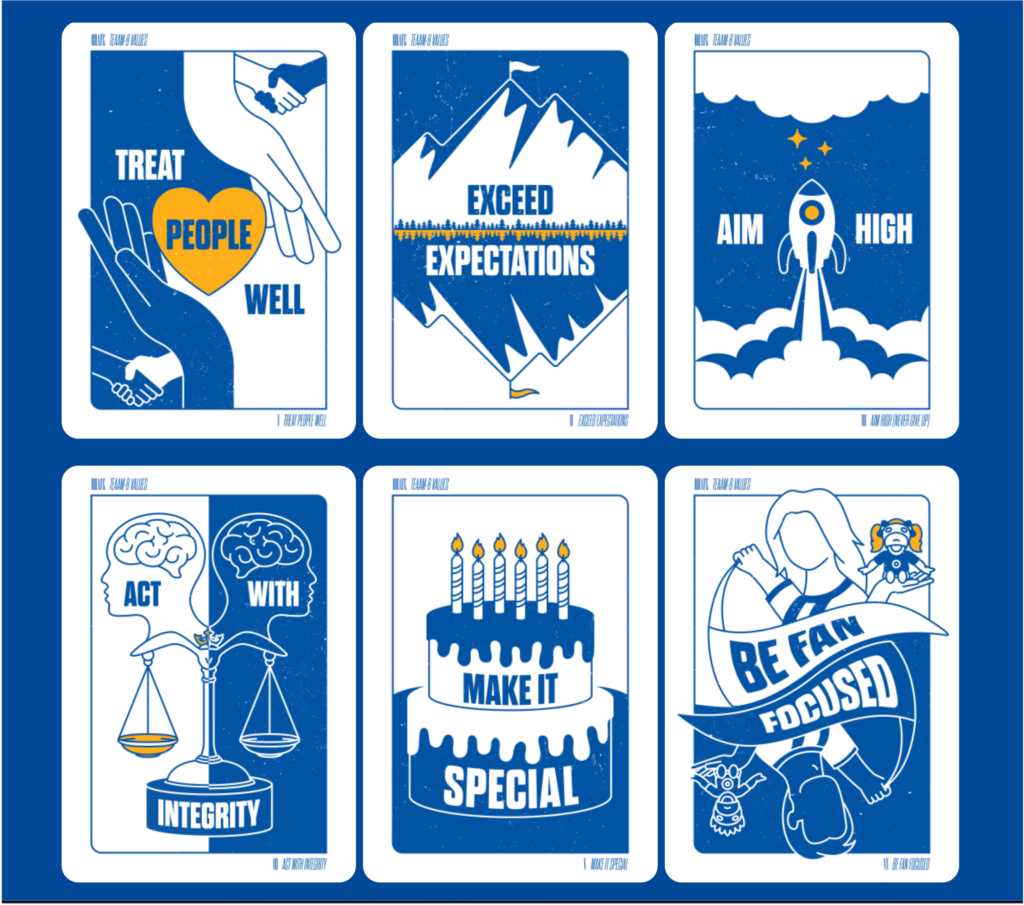
The Albion have a set of values. They have six. That’s at the top end of what I’d advise for any organisation. But the Albion have made them feel a natural part of the decision making. When Hans Snook was CEO of Orange he got employees thinking about the Orange Way – the natural way of doing business.
For Brighton, Paul sums it up as “just doing things properly.”
That all sounds rather simplistic, but for a people business where entertainment, fair competition, fine details and service are so important, it makes sense.
The club faces hundreds of micro issues every day. Together these issues add up to a lot. As Michael Eisner said of the Disney brand, it is the result of a thousand small actions. On their own the danger is that they are seen as nothing, but together they can add up to a big issue that can be all over the TV and radio and news before you know it. And for Brighton – where integrity is critical to sporting competition – that matters.
Like many others, Paul is clear that values should not be something to put on a wall and leave on the wall. Instead, they put them to work.
I was proud to do this for Royal Bank of Scotland/NatWest Group when we created the Yes Check. A simple device designed to get employees asking questions about how they could ‘just do things properly.
Because an organisation – and Brighton is one of those – ticks when independent judgement is put to work. “There are thousands of micro decisions every single day, so I have to allow control to be devolved, and to trust people. The best way for them to do that with autonomy, but also a degree of consistency, are the values.”
The more the values are used explicitly, the more it becomes ingrained in the culture.
- Am I acting with integrity?
- Am I thinking long term?
- Am I taking care of the customer?
- Am I pushing boundaries?
- Am I thinking smartly?
Fill in your own values.
The point is this, the more this language is aired with every micro decision, the better. In meetings, job interviews, career conversations, workshops: the language needs to be used to guide the actions that will propel the business towards success.
At The Team, we have said this to every client who has asked us to identify and design values. Forget the big launch. First, put them in the tools and get leaders using them in conversations.
Know what’s coming next
As a club, Brighton have become renown in their field for being the well to which the big clubs turn for their succession planning. Chelsea, Manchester United, Arsenal, Liverpool, Tottenham – they have spent millions of pounds taking managers and players from Brighton.
Paul Barber and Tony Bloom do not have that luxury.
Players are not (often) loyal and long-term retention is nearly impossible, so succession planning is a necessity.
To do this Paul has identified the mission critical jobs at the club and identified a RAG status for each. Are they red (in need of development), amber (nearly at optimum performance), green (at the top of their game). He is then able to develop plans for each. This includes succession planning.
And sometimes that involves sitting down with the staff themselves and talking about who their successor might be – the club are very open about this.
This applies to every member of the team. It’s probably no surprise to hear that no sooner did Fabian Herzler (the current Brighton coach) arrive than Tony Bloom and Paul were thinking about his replacement.
This isn’t because they felt he would fail – in fact the Albion have a track record of being loyal to coaches – it’s because they had to be ready for his success. When a business is a smaller fish in a big pond then success inevitably leads to staff being poached.
For all businesses, it’s important to know where people are at with their performance and have open conversations with them about how this needs to change, where they might go next, and who might replace them. Making that a natural part of the culture is a refreshing change to long-term stability.
Make objective decisions and protect your IP
One secret sauce that Brighton have is their algorithm.
It is well known that Tony Bloom’s betting business StarLizard collects data on players from around the world and uses this to identify the next stars. One of the reasons the club moved away from the talent scout model is subjectivity. One person’s idea of who the next Pelé is going to be can be very different to the next person’s.
As Paul told the room, “We try and take the subjectivity out of player recruitment. We replace it with objectivity. It takes the emotion and bias out so that we can compare and contrast accurately.” That’s what gives Brighton the edge – knowing when to strip out the subjectivity and emotion.
In his book The Geek Way, author Andrew McAfee examines the habits of high performing organisations in the tech space, where competition is high and change a constant. He identifies four habits:
- Science – be led by data and evidence
- Ownership – be ready to take responsibility – inaction is not an option
- Openness – be ready to take on board fresh thinking
- Speed – don’t wait for the perfect solution, release and iterate, take first mover advantage
At least three of these are totally relevant to the picture Paul paints.
And that algorithm.
Paul admits to not knowing how it works. He knows how some of it works, but not all of it. Only one person knows, and that is Tony Bloom.
And this is an important message to business. Build your IP and protect it through design. Have experts in one area and experts in another, but don’t give away the family silver by over-sharing what is so important to your core product.
Control what you can control
I will paraphrase Paul again (as I have done throughout):
- Have a clear vision
- Create a strategy to support the vision
- Design values to guide decision making
- Get the best possible people
- Put them in the right jobs at the right time
- Motivate them
- Develop them, and
- Prepare for succession
Control what you can control. As Paul says, “I can’t control form. I can’t control fitness. I can’t control what other clubs are doing.”
Focus on controlling the things that are within your sphere of control and do it obsessively.
Do you need to reassess your Values? If so call us at The Team.