The Art of Working Together
What great collaboration really looks like in practice
Walk into any workshop on collaboration and ask people what makes it work, and you’ll find the same ideas surfacing again and again. Active listening. Clear communication. Shared purpose. Flexibility. Trust.
Today I had the pleasure of working with an Operations teams who demonstrated the principles of great collaboration when they worked on an imagined challenge, all designed to improve how they worked together as a team to deliver excellence.
Afterwards, they reflected on the lessons teams keep rediscovering, and the principles that make them stick.
Too often we forget these principles because we default to norms, so keeping the principles front of mind is critical.
The topline messages:
We’ve mentioned Active listening. Clear communication. Shared purpose. Flexibility. Trust. What does this sound like in quotes:
- “Active listening is the gateway to effective communication.”
- “Collaboration requires curiosity and listening.”
- “The key to effective collaboration is focus – be clear and focus, then get a real outcome.”
- “Collaboration = Listen + Act.”
- “True collaboration is only possible when the goals are aligned.”
- “Collaboration is only possible with clear goals, precise and effective communication.”
These aren’t abstract ideas. They’re the lived experience of people who have sat in rooms together, tried to make something, and worked out – sometimes the hard way – what separates teams that thrive from teams that simply co-exist.
To help us organise our thinking, here are the principles that make the difference.
1. Define The Roles – and Play to Them
One of the most common reasons teams stall is role ambiguity. When everyone thinks someone else is making a decision, nothing gets decided. When everyone thinks they’re in charge, you get conflict.
“Understand clearly your respective objectives before you collaborate.”
Or to put it another way, you have an “obligation and duty to define the roles of each team member, regardless of position or experience.” This streamlines collaboration.
This is precisely the problem that McKinsey’s DARE framework was designed to solve. DARE – Deciders, Advisors, Recommenders, and Executors – replaces the older RACI model with something sharper and more honest about how decisions actually get made.
- Deciders are the only ones with a vote. They determine who needs to be in the room and how a decision will be made.
- Advisors have an outsized voice and shape the decision – but cannot stall it by demanding endless data.
- Recommenders do the analysis, explore alternatives, and illuminate pros and cons for the Deciders.
- Executors carry out the decision. Critically, they should be in the room early – their knowledge of obstacles and opportunities is invaluable.
The practical implication is simple: before you start, name who is who. Don’t leave it to be inferred. As one note put it: “2-way discussions are only right with the correct persons.” DARE makes that clarity non-negotiable.
2. Organise, Adapt as You Go, and Challenge the Rules
Structure matters, but rigidity kills creativity. Great teams build a framework at the start and hold it loosely – ready to adapt – as reality inevitably intervenes.
As the group today identified, “Have a clear scope of work, boundaries and timeline. Then agree with the right team (well-defined actually).” At the same time: “Organize as you go, be flexible and open-minded.”
This is the productive tension at the heart of collaboration: enough structure to move with purpose, enough flexibility to move with intelligence. The teams who do this well, set clear outcome expectations early – “Clear concise outcome expectation” – and then adapt as new information surfaces, checking their map against the territory regularly.
And often we work too rigidly within what we believe to be the rules without challenging them. The received wisdom is not always wise, so check and challenge. Can the rules of engagement change? If they can then there may be a better way of working.
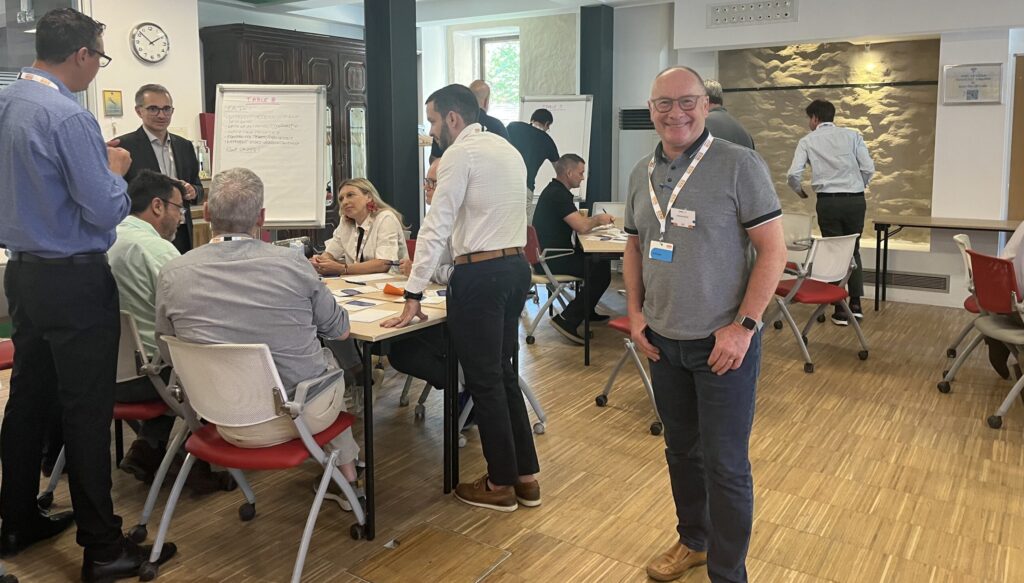
A rule breaker moving between tables during a team exercise and showing how easy it is to challenge rules and break down siloes.
3. Leverage Diverse Experience – or Go Find It
Homogeneous teams feel comfortable and move fast. They also tend to solve the wrong problem brilliantly. Diversity of experience – professional, cultural, generational – is a collaboration multiplier, but only if you actively draw on it.
We captured this tension well: “You may have leveraged diverse experience” – one lesson read, and the word may is the provocation here. Do we actually use the range of perspectives in our teams, or do we default to the loudest voice in the room? And remember, sometimes the loudest voice in the room may not even realise they are being ‘loud’.
As the team today identified, “Understand others’ perspectives and constraints.” “Before moving to the action plan, understand the common problem we want to solve.” Do this by searching our the ‘lived experience.’ Or, as the first principle of Continuous Improvement says: If you can, ‘Go see the problem.’
The goal isn’t diversity for its own sake – it’s better problem definition, richer options, and more robust decisions. Under the DARE model, the Advisors role is where diverse expertise matters most: the right advisors bring perspectives the Decider may not have, and their voice – if heard properly – changes the quality of the outcome.
4. Ask Questions. Ideas Come from Anywhere.
“The key to a successful collaboration: 1. Listen. 2. Listen. 3. Listen.” Only then do you hear the thinking and ideas that will make a difference.
This lesson might be the most important of all. Asking questions is not a sign of weakness or ignorance – it is the engine of collaborative thinking. Teams that stop asking questions stop learning. And teams that stop learning stop improving.
“Listen to all ideas, discuss all the pros and cons and challenge all for the best outcome.” The provocation here is democratic: ideas can come from anywhere. From the most junior person in the room. From the person who least expected to have a view. From the question that felt too basic to ask out loud.
In the DARE framework, this is partly the domain of Recommenders – those who explore and illuminate options – but the best collaborative cultures extend this mindset to everyone. There are no tourists in a high-performing team.
5. When You Listen for Feedback – Act on It (or Explain Why you are Not)
There is a specific failure mode in teams that ask for feedback but never visibly act on it. People stop sharing. Honesty disappears. The team starts to perform collaboration rather than have the real honest debates needed. Nothing moves forward at pace.
As the team today said, “active listening and openness for ideas, obtaining data for making decisions.” “Listen carefully, as well as explain clearly what you see as opportunity.” “Be a listener to all members of the team and act upon final decisions – be decisive and action-oriented.”
This closing phrase matters: be decisive and action-oriented. Listening without acting is just politeness. The standard should be: if you heard it, you either acted on it, or you explained – clearly and respectfully – why you didn’t. This closes the loop. It tells people their input was genuinely received, not just collected.
Remember the principles of transactional language. Make clear explicit requests and be clear on the answer you are expecting to hear. Do not progress under the assumption that a decision has been made. Get commitment.
6. Build on Each Other’s Ideas. No Egos.
“Know what the other teams wants as an outcome and see where it adds to what you are doing or where you can add to it.” This will only come from “Sharing knowledge and strategy” from the outset. As one team member put it, “at the start of our exercise on collaboration we should have brought everyone together to hear what they were presenting and what they saw as priorities.”
And the more we work as one team and not as individuals with our own agendas, the more we “build lasting trust” which acts as the fuel for faster mire effective collaboration.
Ego is collaboration’s most persistent enemy. It shows up as the person who can only support ideas they originated. It shows up as the leader who interprets challenge as disloyalty. It shows up as the team that performs consensus while privately pursuing individual agendas.
The antidote is a culture of building – where the rule is that you take an idea, make it better, and pass it on. This is not about being passive or deferential. It’s about being genuinely invested in the outcome rather than in being seen to have contributed to it. “Don’t focus on the money without being aligned on the business case.” In other words: focus on what you’re actually trying to create together.
7. Check In Regularly
“Check the common goals.” “Align objectives.” “Identify the key stakeholders early and ensure you keep stakeholders engaged.”
Teams drift. Priorities shift. Assumptions go stale. The teams that sustain great collaboration don’t just set up well at the start – they return to first principles regularly. Are we still solving the right problem? Are our roles still right? Are the Deciders still the right Deciders?
Under the DARE framework, this kind of regular review is especially important because role clarity has a tendency to blur over time. The Advisor starts making decisions. The Executor starts recommending. Without deliberate check-ins, the clarity that DARE provides at the start erodes – and with it, the speed and quality of decision-making.
A simple recurring question identified in the room today works: “Are we still aligned on what we’re trying to achieve, and does everyone know their role in getting there?”
The Bigger Picture
What the lessons ultimately reveal – and what the DARE framework formalises – is that collaboration is not a soft skill. It is a discipline. It requires deliberate design: of roles, of processes, of communication norms, and of culture.
The teams that collaborate best are not the ones with the most talented individuals. They are the ones who have learned to pool their intelligence rather than compete with it. Where listening is as valued as speaking. Where role clarity enables – rather than constrains – creative contribution. And where checking in is seen not as a sign of weakness, but as the mark of a team that takes its own performance seriously.
“Collaboration: open and transparent communication to build trust.”
In summary:
- Always define roles, and be ready to play to your role
- Organise, and adapt as you progress – challenge the rules
- Leverage the diverse experience in your team, or find that experience
- Ask questions – remember ideas can come from anywhere
- Listen for feedback and either act on it or explain why you are not
- Build on each other’s ideas – no egos. Egos are pointless.
- Check-in regularly
Or to use a metaphor:
Imagine a team of architects gathering to design a building. Before anything else, they speak up and assign who draws what – no one steps on each other’s toes. As the project evolves, they adjust their plans when the ground shifts. They’re smart enough to tap into each other’s specialisms – the one who knows acoustics, the one who knows light. When something’s unclear, they ask. When someone pushes back, they truly hear it. And every great idea becomes a foundation the next idea is built on.