Is your AI for the good of the company or the good of the customer?
Barclays is asking itself that same £2.3bn value proposition question: is AI for the good of the company or the good of the customer? And what do all these AI decisions mean for long term brand health?
On 22 October, Barclays reported a 12% rise in third-quarter pre-tax profit to £2.3bn. In the same statement, it announced 5,000 job cuts, around 5% of its workforce, linked to its bid to unlock simplification and AI-driven efficiency. A £500m share buyback came alongside.
Barclay’s CFO says around 60% of the cuts fall in support functions, not frontline roles. This isn’t a bank dismantling its core customer interfaces.
But it is a lesson in framing. When record profit, job cuts, AI and a buyback share one announcement, nobody reads the footnotes. Customers and colleagues read the headline, and the headline asks: is this investment in my experience, or extraction from it?
Why it matters: Banks can embrace AI without sacrificing customer centricity. The winners will use technology to deepen trust, not to replace it. And that makes it a brand question as much as a technology one.
Banking is personal – or should be
Your bank holds your salary, your savings and your plans. It is a simple human truth that people judge relationships like that on how they’re treated when it matters most. Those celebratory moments, as well as the difficult ones.
The data supports that view:
- 57.7% of UK banking customers would prefer a person to AI for customer service. Just 9.2% would be comfortable using AI for most queries.
- UK consumers reserve certain moments for people: emergencies, complex problems and sensitive disclosures.
- Yet they happily accept AI for fraud detection, identity protection and 24/7 service. Not for advice.
Customers aren’t anti-AI. They welcome AI working for them in the background. They resist AI standing between them and their bank.
Behavioural science explains why. The peak-end rule tells us people remember an experience by its most intense moment. In banking, that peak is often the worst day of a customer’s financial year: a fraud, a bereavement, a missed mortgage payment, or when juggling 101 thoughts and getting very confused. Automatation is made for routine tasks. Employees must deal the customer’s peak moments .

The plot twist: digital isn’t the differentiator
The fintechs show AI at its best. Revolut uses it to review ten times more potential fraud cases each day, protection customers can feel. Monzo reached 15.2 million customers, 79% of them by word of mouth, with an NPS of 76 against an industry average of 30. (It isn’t flawless: its latest results include an FCA fine.)
But here’s the complication. Kantar finds the UK’s customer satisfaction leaders are people-centric incumbents, First Direct and Nationwide. In recent account openings, Monzo ranks seventh and Revolut ninth.
Customer centricity wins, whatever the channel.
Nationwide’s costly signal
Nationwide has cut roughly 875 roles this year after integrating Virgin Money. Back office, not customer-facing, and not linked to AI.
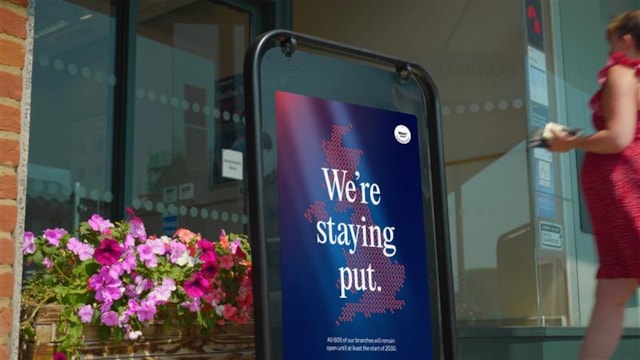
What customers hear instead is the Branch Promise: all 605 branches open until at least the start of 2030, including 152 that are the last branch in town. Nationwide topped July’s UK Customer Satisfaction Index.
Behavioural scientists call this costly signalling. A promise that costs nothing is cheap talk. A promise that costs real money gets believed. Same kind of cuts as everyone else; a completely different story.
But it is also about staying close to the customer, and being ready to make judgement calls. Interestingly, it is something The Team worked on internally with Nationwide when looking at how managers stay close to employees.
If marketing owns growth, brand matters more
Plenty of CMOs have carried growth, customer experience and commercial performance for years. That’s nothing new.
What is new is the pace. Forrester’s latest analysis finds only 36% of Fortune 500 companies now use the title “chief marketing officer”, down from 49% a year earlier. In its place: chief growth officer, chief commercial officer, chief customer officer.
That makes sense. Marketing should be able to prove the value it creates.
But here’s the tension. You can generate more leads, lift conversion and make every campaign work harder. If people don’t understand what makes you different, why it matters to them or why they should choose you, there’s only so far that activity can take you.
That’s the core job of brand. Not just a distinctive identity or a compelling message, but a clear direction that shapes products, customer experience, employee behaviour and communications.
Behavioural science backs this up. Most choices are made fast, on instinct, with limited attention. A strong brand is the shortcut that makes choosing you easy. Nationwide’s Branch Promise isn’t a campaign. It’s brand acting as direction, and it shows up in the operating model.
Forrester itself reads the trend as “reinvention”, not decline. I agree. This shift is an opportunity to stop treating brand as something marketing delivers, and start treating it as a lever that helps the whole business grow. In short, a business growth enabler, not a delivery function.
Trust is a growth line, not a cost line
- Customers who advocate for their bank hold 17% more products and give it 5–30% more share of wallet.
- The Institute of Customer Service links higher satisfaction to better financial performance. In July, banks overtook retail in its index for the first time.
- The FCA’s Mills Review confirms the Consumer Duty as the anchor for AI in retail finance. With 11 Consumer Duty investigations opened in two years, customer outcomes now carry regulatory weight.
If we’re going to hold marketing accountable for growth, we need to recognise the role brand and trust play in creating it.
Making AI read as customer value
Have you thought about how your next efficiency announcement will be felt, not just reported?
- Explain the logic. 33% of Britons would trust AI guidance if it explained its reasoning step by step.
- Keep a human in the loop. A further 24% would trust it with human review available.
- Lead with the benefit, not the saving. Framing matters: “faster fraud protection” lands; “cost reduction” doesn’t.
- Protect choice. Make digital the easy default, never the only door.
This is exactly what our Proposition Engineering™ work is for: aligning the customer proposition, the employee proposition and the operating model, so that AI efficiency and customer value tell one story. Because colleagues who wonder if they’re next rarely deliver the warmth customers remember.
Use AI to clear the queue. Never to empty the room.