The Artworker in the age of AI:
There is a specific sound a design studio makes when a deadline is looming, the nervous agitation of the project manager who is in charge of the unrealistic deadline and budget. The creative director sitting on your shoulder making last-minute changes. For thirty years, I’ve been part of that soundscape as an Artworker. I’ve seen the transition from physical paste-ups to QuarkXPress, then Adobe InDesign, and the shift from print to ‘digital everything’.
Today, there’s a new sound in the studio: fingers on keys tapping out a prompt being typed into an AI generator which will hopefully spit out a social media campaign in all the correct formats.
I’m in my 50’s, with three decades of production under my belt, I’ve had more than one moment where I’ve wondered if I should trade my Creative Cloud subscription and re-train as a plumber. Are we becoming an endangered species? Has AI finally come for the technical soul of the design industry?
The short answer is: No. But the role is changing faster than you can say 4-colour process.
The ‘magic button’
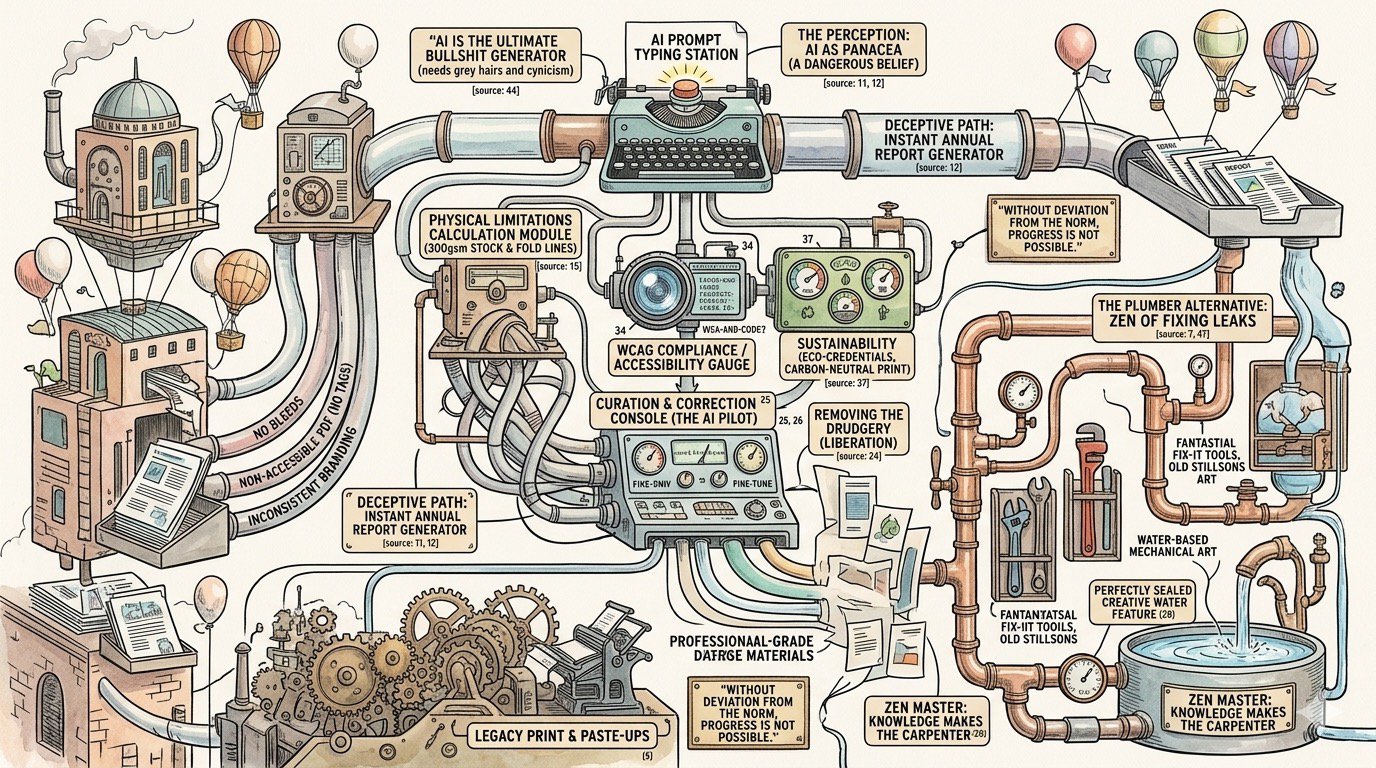
The biggest threat to the Artworker isn’t actually AI; it’s the perception of AI as a panacea. There’s a dangerous belief floating around that you can simply type “make me a 16-page sustainable annual report” into a box and out pops a print-ready PDF with perfect bleeds, accessible tagging, and spot-on brand consistency.
Anyone who has actually touched a production file knows that’s just isn’t the case.
AI is incredible at generating, but it’s rubbish at finishing. It doesn’t understand the physical limitations of a 300gsm recycled stock, nor does it know that a 2mm shift in a fold-line will ruin a high-end packaging piece. And it certainly doesn’t care about the ethical nuances of the green agenda or ensuring a document is truly accessible for a screen reader.
This is where 30 years of experience becomes your superpower. AI can give you a head start, but it lacks the ‘eyes’ to see when a file is technically broken. We aren’t just “button-pushers”; we are the gatekeepers of quality.
The Artworker: from ‘creator’ to ‘editor-in-chief’
In the past, an Artworker spent hours retouching a complex image or meticulously cloning out stray hair. Today, Adobe Firefly or Generative Fill in Photoshop can do it in seconds. If you view that as ‘stealing my job,’ it’s a gloomy outlook. If you view it as ‘removing the drudgery,’ it’s a liberation.

The role is shifting from the manual labour of creation to the high-level task of Curation and Correction. We are becoming ‘AI Pilots’, we use the tools to do the heavy lifting, and then we apply our decades of knowledge to ensure the output actually meets professional standards.
I love woodworking as a hobby, and I know power sander doesn’t make you a carpenter; knowing which grade of sand paper to use and when the surface is truly level does. AI is just the newest power tool in the shed.
Is this the end of print as we know it?
It’s true, print volumes aren’t what they were in the 90s, but print isn’t dying; it’s becoming special.

As digital output reaches a fever pitch, high-end, sustainable, tactile print is becoming a premium experience. However, to stay relevant, todays artworker needs to look beyond the process colours. Here’s where to focus your training:
Accessibility (WCAG Compliance): This is massive. As the world moves toward mandatory digital accessibility, the ability to take a complex InDesign layout and export a perfectly tagged, navigable, and compliant PDF is a high-demand skill. It requires the same technical pedantry we’ve always had, just applied to a different output.
Sustainability in production: Being passionate about the environment, I strive to find suppliers good eco-credentials. Becoming an expert on low-ink coverage, eco-friendly substrates, and carbon-neutral print workflows is a massive value-add for agencies trying to meet B-Corp status.
Motion and Interactive Elements: You don’t need to become a Pixar animator, but understanding how to prep assets for social media and motion is the natural evolution of the Artworker.
The human element (the ‘anti-BS’ factor)
In a world gone bonkers with ‘manufactured’ content – much like generic, auto-tuned pop songs that plague the charts, there is a growing hunger for authenticity.
AI produces what is statistically likely; it doesn’t produce what is right or human. It doesn’t have a moral compass or nuance. And it won’t tell a client, “This route will isn’t accessible,” or “We’re wasting paper in this format.”
My philosophy has always been simple: treat people with common decency and don’t tolerate bullshit. AI is, in many ways, the ultimate bullshit generator. It can produce infinite variations of “fine and okay”, but it takes a human being, one with 3-decades of experience, a few gray hairs and a dash of cynicism to find the “great”.
So, what’s the future for the Artworker
Should I thrown in the towel and retrain as a plumber; trade my Wacom tablet for Stillsons? Maybe… there’s a certain Zen-like appeal to fixing a leaky tap, but the design world needs people who remember how to do things the way they are supposed to be done. AI won’t kern a heading so the characters are beautifully spaced – it probably doesn’t even know what trapping is.
Frank Zappa said, “Without deviation from the norm, progress is not possible”. The output of AI is normal, it’s an average of everything that came before it. It takes a seasoned Artworker to provide the nuance, the soul, and the technical perfection that makes a project authentic.
We are in a step-change. The ‘artwork’ is no longer just about the final file; it’s about the process, the ethics, and the technical integrity. Use AI as a tool, let it do the boring bits. But never let it have the final say.
I’ll be keeping the Adobe subscription for now.