Why organisational trust is a business KPI (whether you measure it or not)
Internal organisational trust is one of those things every business agrees is important, right up until it’s tested. When decisions slow down, strategies stall, or execution starts to feel inconsistent, the conversation rarely turns to trust. Instead, leaders talk about alignment, clarity or delivery. But more often than not, those issues share the same root cause.
Trust hasn’t disappeared; it’s just rarely treated as something to actively manage.
Trust already shapes performance; we just don’t call it that
Most organisations don’t think they have a “trust problem”. What they experience instead are symptoms:
- Decisions that take longer than they should
- Repeated alignment meetings that don’t actually align
- Leadership teams pulling in slightly different directions
- Strategies that look strong on paper but struggle to land internally
These aren’t simply operational issues. They’re signals.
When trust is high, teams move faster, challenge more openly and commit more confidently.

When it’s low, even the best intentions get bogged down in caution, consensus-seeking and second-guessing.
And part of the challenge is that “trust” is a broad, intangible notion. Mark Hauser, our Applied Behavioural Scientist & Strategist comments:
Trust extends beyond leadership into systems, culture, decision-making and politics. And even within leadership teams, there are always some people you trust, and others you don’t.
Trust also isn’t one thing. We can trust someone’s values but not their competence. Their intention, but not their influence. Their clarity, but not their compassion. Yet as employees, we rarely break trust down into these component parts. We tend to land on a summary judgement: I do / don’t trust them.
That’s exactly why it can be so fundamental to performance, and yet so frequently overlooked.
As Sally Tarbit, director at the Team, puts it:
Internally, I would say that trust is inextricably linked to psychological safety – they’re effectively two sides of the same coin. Trust is confidence in others, such as colleagues and leadership, while psychological safety is confidence to speak up, fail and challenge without fear of blame. Together, they turn workplaces into high performing environments where people are motivated, speak up, take risks and grow.
Why internal organisational trust is treated as intangible
Despite its impact, trust often sits outside formal measurement. There are a few reasons for that.
First, it feels emotional. Unlike revenue or growth, trust doesn’t arrive neatly packaged in numbers. Second, it can be uncomfortable. Measuring trust risks surfacing things leaders might not be ready to address.
And finally, it’s often assumed. Once values are written down and culture statements agreed, trust is expected to follow.
But businesses already measure things that are just as complex. Engagement, sentiment, loyalty and confidence all fall into this category. Trust underpins every one of them.
When trust isn’t measured, it doesn’t disappear. It simply becomes invisible — and what’s invisible is hard to manage.
Treating trust like a KPI (without turning it into a tick box)
Research from Harvard Business Review has repeatedly shown that trust plays a critical role in performance, engagement and decision-making, yet is rarely treated with the same discipline as other business metrics.
As one HBR article puts it: “Compared with people at low-trust companies, people at high-trust companies report 74% less stress, 106% more energy at work, 50% higher productivity, 13% fewer sick days, 76% more engagement, 29% more satisfaction with their lives, and 40% less burnout.”
Treating trust as a business KPI doesn’t mean adding another survey or chasing a single score. In reality, trust shows up most clearly in behaviour, and often in specific facets of behaviour that reveal what kind of trust is present (or missing).
You can see it in:
- How quickly decisions are made and owned
- How consistently leaders talk about strategy and priorities
- Whether teams can challenge ideas without fear
- Whether people trust the process, not just the people in the room
- Tangible follow-through after direction is set
- Whether confidence is built through competence, care, clarity or undermined by gaps in any of these.
These signals are often easier to spot than people think. They’re already present in meetings, feedback loops and day-to-day interactions. They just aren’t always named or connected back to trust.
Making trust visible isn’t about control. It’s about awareness.
What unmeasured trust costs your brand
This is often where trust starts to show up indirectly.
When trust is low or uneven across an organisation, other interventions get asked to compensate: more alignment sessions, more comms, more frameworks, more process. Everyone works harder around the issue, without necessarily addressing it.
And this is the moment where brand work is frequently brought in to clarify, align, and fix what feels broken. But without trust, even the strongest strategy struggles to take hold.

Research into organisational health has consistently shown that trust, alignment and confidence are critical to sustained performance, particularly during periods of change.
We see this most clearly during moments of change. Rebrands, leadership transitions, mergers or periods of growth all put trust under pressure. The brand might be well thought through, but if confidence in direction is shaky, execution falters. Messages become diluted. Decisions get deferred. Consistency suffers.
The result is a gap between what an organisation says and how it actually shows up. And that gap is noticed by teams, customers and partners alike.
Making trust visible, actionable and strategic
When trust is treated with the same intent as other business metrics, something shifts.
Leaders gain clearer insight into what’s really slowing progress. Teams understand where confidence is strong, where it needs rebuilding and what kind of trust is missing. Strategies land more effectively because the conditions are right for them to do so.
Internal organisational trust doesn’t become a KPI to make it clinical, but to make it actionable.
Because the question isn’t whether trust matters. It’s whether you’re willing to manage it with the same discipline as the rest of your business.
Final thoughts
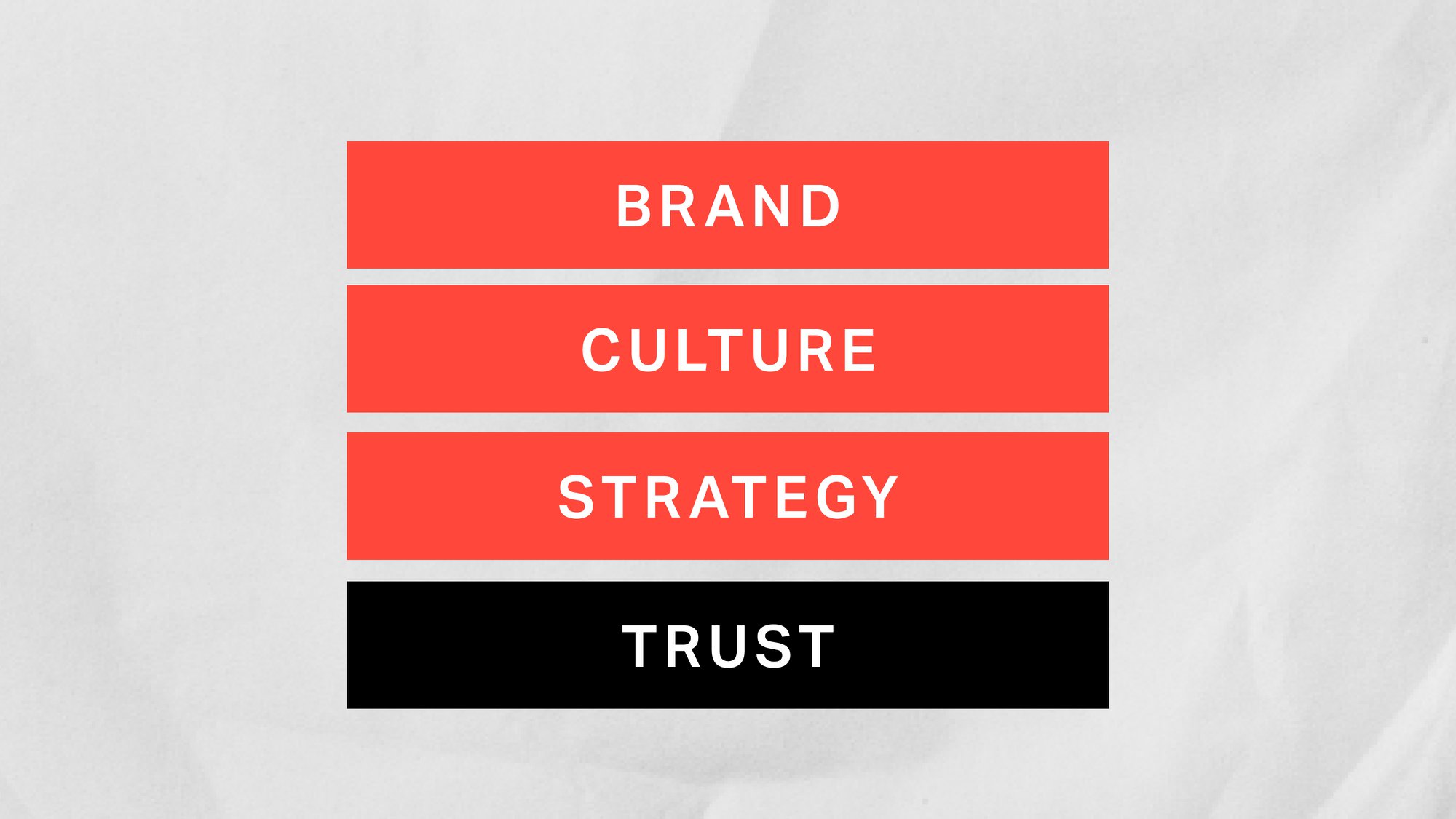
When trust is low, brand is often asked to fix the symptoms. Clarity, consistency and alignment all come under pressure. But without trust, even the best work struggles to land.
At The Team, we work with leadership teams to understand what’s really shaping performance beneath the surface, and how brand can help build confidence, alignment and momentum when it matters most.